Apartment Noise Management Committees in Seoul and Gyeonggi: Why Operation Matters More Than Formation
Apartment Noise Management Committees have existed in South Korea for years, but formation alone does not reduce disputes. Data provided by the Housing Culture Improvement Research Institute shows complaint reduction rates above 70% when committees are properly organized, trained, and operated.
When discussing apartment noise management in South Korea, one question is often asked first:
“Does this apartment complex have a Noise Management Committee?”
But experience in the field suggests that there is a far more important question:
“Does the committee actually operate?”
Apartment Noise Management Committees have existed in Korean apartment communities for years under apartment management rules and guidelines.
Many complexes formed committees, appointed members, and completed the necessary paperwork.
But in some cases, that was where the process ended.
The committee existed on paper but rarely met, received little practical training, and played almost no role when real noise complaints occurred.
That is why the real issue is no longer simply committee formation.
It is committee activation and operation.
Seoul and Gyeonggi Provide a Framework for Noise Management Committees
Both Seoul and Gyeonggi Province provide frameworks within their apartment management guidelines for organizing and operating committees that address disputes over noise between floors.
The detailed structure may differ, but the underlying purpose is similar: apartment noise disputes should not be left entirely to the management office.
Residents, apartment representatives, management personnel, and committee members need a structured mechanism for addressing conflicts within the community.
However, having rules in place does not automatically reduce complaints.
A committee written into an apartment's management rules is very different from a committee that actually responds when a resident asks for help.
The Committees Existed Before—But Many Were Only Formal Organizations
This is an important point.
Apartment Noise Management Committees are not entirely new.
Years ago, many apartment complexes established committees in accordance with their management rules.
A property manager, resident representatives, and other community members might have been appointed.
But what happened afterward?
In some complexes, meetings were rarely held.
Members received little practical training.
When a noise complaint occurred, the management office continued handling it in the same way as before.
Committee members often did not know what to inspect during a site visit, what questions to ask, or how to speak to residents involved in a conflict.
The committee existed.
But the system did not operate.
The Key Metric Should Be Activity, Not Installation
Imagine two apartment complexes.
Both have an Apartment Noise Management Committee.
In Apartment A, there is simply a list of committee members.
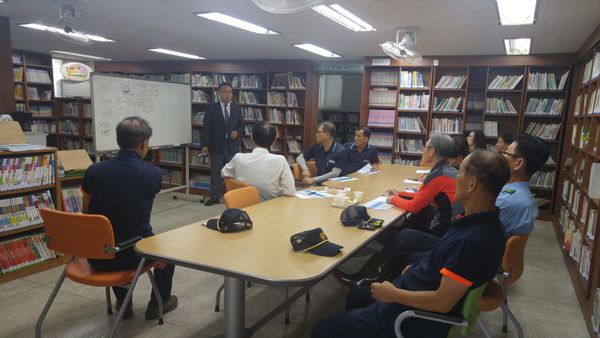
In Apartment B, members receive training. When a complaint occurs, they review the case, visit the affected household, communicate with the relevant residents, participate in mediation, and follow up afterward.
Should both communities be described as having the same noise-management capability?
Clearly not.
This is why the key question should shift from:
“Has a committee been established?”
to:
“What has the committee actually done?”
Complaint Reduction Rates Exceeded 70% in the Provided Data
The data provided by the Housing Culture Improvement Research Institute offers an important perspective on the potential effectiveness of properly organized and trained committees.
| Research / Program | Apartment Complexes | Complaint Reduction Rate |
|---|---|---|
| Housing Culture Improvement Research Institute & Association for Residential Noise Management, 2020–2022 | 1,822 nationwide | 72.4% |
| Seoul Metropolitan Government & Housing Culture Improvement Research Institute, 2022 | 414 in Seoul | 70.4% |
| Ministry of Environment pilot program, 2013 | 33 nationwide | 73% |
The most striking feature is the consistency.
72.4%.
70.4%.
73%.
Although the studies covered different periods and groups of apartment complexes, the figures presented in the source material all exceed 70%.
The largest dataset listed—covering 1,822 apartment complexes nationwide from 2020 to 2022—reported a 72.4% complaint reduction rate.
These figures support an important practical point:
A Noise Management Committee can be effective when it is properly organized, trained, and actively involved in real cases.
The committee's value therefore comes not from its name or membership list, but from what it actually does.
What Does an Active Committee Actually Do?
An effective committee should not simply hold a meeting after a serious dispute has already developed.
A practical process may look like this:
Complaint received → Site review → Identify the affected resident's priority request → Contact relevant household → Committee mediation → Follow-up
The final step is particularly important.
Apartment noise disputes are rarely solved by telling someone to “please be more careful.”
The committee needs to determine whether the problem continues after mediation.
If the same complaint returns repeatedly, the previous intervention may not have addressed the underlying conflict.
This is why follow-up management is part of dispute resolution, not an optional extra.
The Management Office Should Not Carry the Entire Burden
Another important issue is the division of responsibilities between the apartment management office and the committee.
Most management offices do not have a staff member dedicated exclusively to noise disputes.
Staff may simultaneously handle facilities, accounting, parking, repairs, security, and general resident complaints.
It is unrealistic to expect them to manage every noise dispute continuously from beginning to end.
A clearer model is needed.
The management office can focus on:
Listening to the complaint → Recording the resident's highest-priority request → Conducting an initial site visit → Organizing the information → Reporting the case to the committee
The committee can then take a more active role in mediation and follow-up.
This division makes the process more sustainable.
Stop Measuring Committees by Whether They Exist
If apartment communities want to evaluate whether a Noise Management Committee is working, the checklist needs to change.
Instead of simply asking whether a committee has been established, communities should examine whether members have received relevant training, whether meetings are actually held, whether committee members participate in site visits, how many complaints have been mediated, and whether the same disputes continue after mediation.
In other words:
The important metric is not the committee formation rate. It is the committee activity rate.
This distinction is critical.
A committee that exists only in administrative documents does little for a resident who has been struggling with noise for months.
An active committee, however, can become the apartment community's first line of structured conflict resolution.
Formation Is Only the Beginning
South Korea has already experienced the limitations of simply requiring committees to be formed.
Committees were established.
Members were appointed.
But in many cases, genuine activation did not follow.
The next stage therefore needs to focus on a complete operational cycle:
Formation → Training → Field Response → Mediation → Follow-up
Only when these steps are connected can an Apartment Noise Management Committee become a functioning dispute-resolution body rather than an administrative formality.
And the complaint-reduction figures provided by the Housing Culture Improvement Research Institute and related programs suggest that properly operated committees have considerable potential.
The question is no longer whether these committees can work.
The more important question is:
If they can reduce complaints, why have so many Apartment Noise Management Committees struggled to become active?
That will be the subject of the next article.
Next Article
Why Do Apartment Noise Management Committees Fail to Become Active?
In the next article, we will examine the practical barriers that prevent committees from functioning effectively—including limited professional knowledge, insufficient training, uncertainty about responsibility, low resident trust, unclear roles between committees and management offices, and a lack of practical field protocols.