When Should Residents Start Preparing for Construction Damage Compensation?
Construction damage compensation should begin long before the final settlement. Learn why early resident organization, transparent negotiations, documentation, mitigation planning, and expert support matter in noise, vibration, and dust disputes.
The best time is at the beginning of the project—not when construction is almost finished
Residents living near a major construction site often wait until the damage becomes severe before thinking about compensation.
By then, construction noise may have continued for months, dust may have repeatedly entered homes, vibration may have caused ongoing concern, and heavy construction vehicles may have disrupted daily access.
Only then do residents begin asking:
“Can we receive compensation?”
But in practice, the more important question is:
“When did residents begin managing the problem?”
Construction damage compensation is not simply a negotiation that begins at the end of a project.
It should be prepared from the early stages of construction.
Why early action matters
Construction impacts change significantly depending on the phase of work.
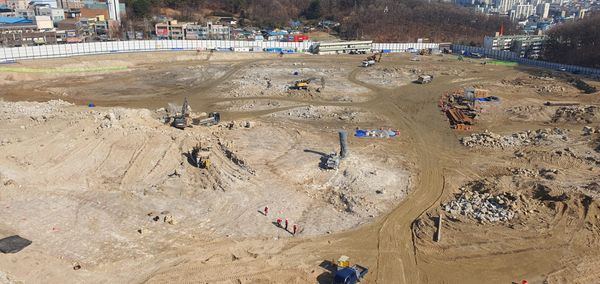
Excavation and earthwork may generate heavy equipment noise, vibration, and dust.
Structural work may involve concrete pouring, pumps, trucks, cranes, and extended working hours.
Some of the most disruptive activities may disappear by the time residents decide to take formal action.
If residents wait until the project is nearly complete, it can be difficult to reconstruct what happened months earlier.
Early action creates something extremely important:
a continuous history of the damage and the response to it.
Why apartment management offices are reluctant to lead compensation claims
When construction problems begin, residents usually contact the apartment management office first.
They may ask the office to complain to the contractor, arrange noise measurements, or negotiate compensation.
But construction damage compensation is not normally the core responsibility of an apartment management office.
The damage is suffered by individual residents, and any eventual compensation is also generally connected to those affected residents.
Expecting apartment management staff to negotiate compensation for months, determine the value of claims, and manage the distribution of compensation creates significant operational and legal burdens.
For this reason, management offices often limit their role to forwarding complaints, contacting the construction company, or providing information about relevant public authorities.
Why resident representative councils also struggle
The next question is usually:
“Why doesn't the resident representative council handle it?”
Resident representatives can play an important role in organizing community concerns.
However, construction compensation disputes require specialized knowledge.
Residents may need to consider the distance between the construction site and affected buildings, the orientation of apartment units, the number of exposed households, construction phases, noise and vibration characteristics, and the history of complaints from the beginning of the project.
Most resident representatives have never handled such a case before.
There is also another very practical problem:
Who is willing to take responsibility?
Negotiations with a contractor may continue for months.
Someone must attend meetings, speak with residents, organize complaints, review proposals, and explain decisions.
If compensation is successful, residents may see the result as expected.
If the amount is lower than residents hoped, the person who led the negotiations may become the target of criticism.
That is one reason many communities struggle to find someone willing to lead the process.
The most difficult stage may come after compensation is offered
Residents often assume that once the contractor agrees to pay compensation, the problem is solved.
In reality, another conflict may begin.
Who receives the money?
Should apartments closest to the site receive more?
Should units directly facing the construction site be treated differently from units on the opposite side?
Should residents who lived through the entire construction period receive the same amount as those who moved in later?
How should tenants and owners be treated?
Should households reporting severe damage receive more than those reporting limited impact?
These questions can create serious conflict inside the residential community.
For that reason, construction compensation should not focus only on how much money can be obtained.
Residents should also establish how any compensation will be distributed before final agreements are made.
Compensation negotiations should not be controlled by one person
Because money is involved, transparency is essential.
A single resident representative should not conduct all negotiations privately with a contractor while other residents remain unaware of the terms being discussed.
This is not simply about preventing wrongdoing.
It also protects the resident representative.
A safer process includes multiple representatives in formal meetings, written meeting records, disclosure of major proposals and conditions, and clear resident approval for important settlement terms.
Compensation should not be handled through an individual's personal account.
Distribution criteria should also be explained before money is paid.
The principle is simple:
Before negotiating compensation, build a transparent decision-making system.
Form a resident emergency committee early
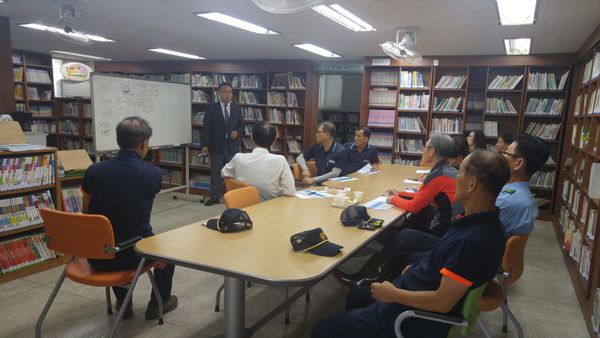
When construction damage is expected or complaints begin to increase, residents should consider establishing a resident emergency committee or similar autonomous representative body.
Its purpose is not simply to protest against construction.
It should become the formal communication channel between residents and the developer or contractor.
A properly organized committee can collect individual complaints, coordinate resident requests, discuss mitigation measures with the construction company, and manage compensation discussions over the long term.
The committee should not concentrate all authority in one chairperson.
Shared decision-making and transparent documentation are far more sustainable.
Do not begin with money—begin with damage reduction
At the beginning of construction, residents should not focus exclusively on asking:
“How much compensation will we receive?”
The first priority should be reducing actual harm.
Residents and contractors can discuss issues such as advance notice of particularly noisy work, concrete pouring schedules, nighttime construction, construction vehicle routes, dust control, wheel-washing facilities, water trucks, and pedestrian or vehicle safety near apartment entrances.
For especially disruptive nighttime or concrete work, the contractor can provide advance written notice to the apartment complex, allowing the community to inform residents beforehand.
This does not eliminate the noise.
But it can reduce unexpected disruption and lower the intensity of complaints.
Distance and exposure matter
One of the important factors in evaluating construction impacts is the relationship between the construction site and the affected residential buildings.
Distance matters.
But distance alone is not enough.
It is also important to examine whether a building directly faces the site, whether another structure blocks the exposure, and how many households are realistically affected.
A general statement such as:
“We can hear construction noise in our apartment complex.”
is far less useful than identifying which buildings, orientations, and households experience the strongest impacts.
This should be reviewed early.
Resident-collected evidence is useful—but it does not automatically produce compensation
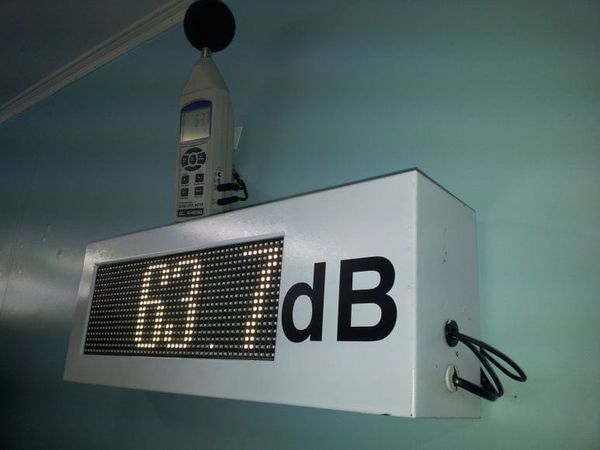
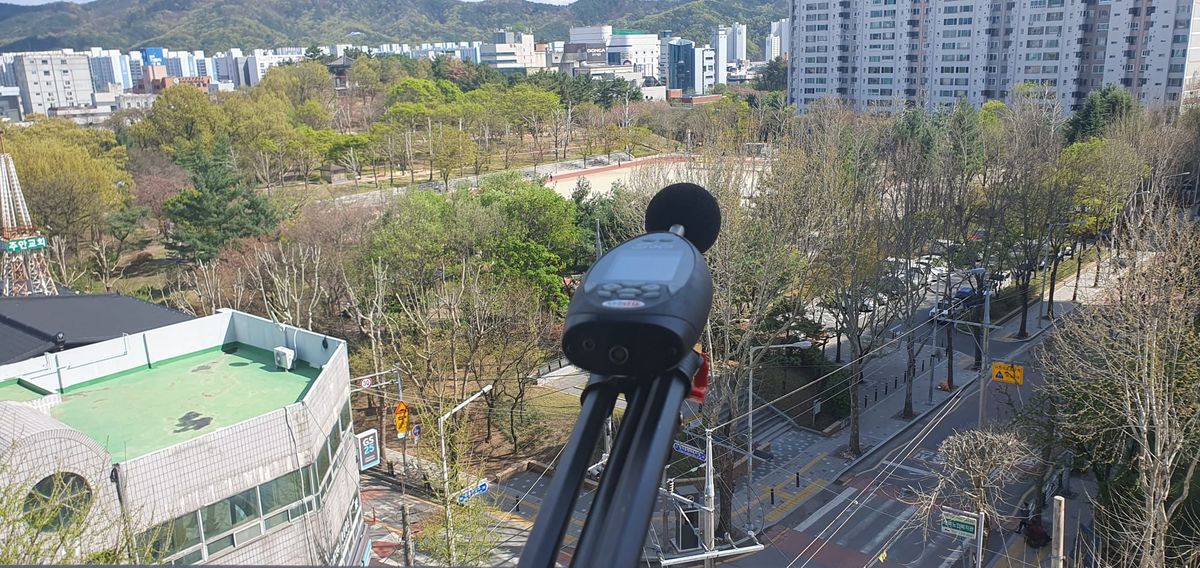
Residents often collect smartphone noise measurements, videos of construction work, photographs of dust-covered windows, and records of truck movements.
These materials can help explain what residents are experiencing.
But they do not automatically determine compensation.
The key questions remain:
Which construction activity caused the impact?
How strong was the relationship between the site and the reported damage?
How wide was the affected area?
What evidence is relevant to negotiation or technical assessment?
Therefore, the goal should not be simply to collect more evidence.
It should be to collect the right evidence for the right purpose.
When residents cannot manage the process alone, expert support may be necessary
Construction damage compensation is not simply a complaint process.
It may require site analysis, identification of affected households, complaint management, mitigation discussions, construction monitoring, technical interpretation, and finally compensation negotiations.
Resident representatives handling such a dispute for the first time may find it difficult to decide what should be done first.
This is where experienced technical support can be valuable.
How the Housing Culture Improvement Research Institute supports residents
The Housing Culture Improvement Research Institute (HCRI) has worked on construction-related residential damage involving noise, vibration, dust, and compensation disputes.
Its role is not simply to tell residents:
“Demand this amount from the contractor.”
A more practical approach begins with understanding the site.
The institute can assist with reviewing construction conditions, identifying potentially affected buildings and households, organizing resident response structures, supporting resident meetings, discussing mitigation measures with contractors and developers, and helping structure longer-term compensation negotiations.
The objective should not be unconditional confrontation between residents and the construction company.
The contractor must continue construction.
Residents must continue living in their homes.
A more workable structure is one in which the contractor makes reasonable efforts to reduce damage, while the resident committee organizes individual complaints and avoids unnecessary duplication of the same complaint.
This type of cooperation can create a better environment for both mitigation and eventual compensation discussions.
Expert advice is often more valuable early than late
Residents sometimes seek professional assistance only when construction is almost complete and compensation negotiations are about to begin.
By then, important information may already be lost.
Major excavation or structural work may be over.
Earlier noise and vibration conditions may no longer be observable.
Records of discussions with the contractor may be incomplete.
Early involvement allows residents to review upcoming construction phases, identify which buildings may be most exposed, determine what mitigation measures should be requested, and establish a documentation strategy before the most disruptive work occurs.
For this reason, expert support may be most valuable before compensation is discussed in detail.
Why waiting until the end can weaken the residents' position
Imagine that residents first raise compensation after the major noisy construction phases have ended.
The contractor may ask:
“What formal complaints were raised during the project?”
Residents may have genuinely suffered for a long period.
But if there is little documentation showing when complaints began, what mitigation was requested, how the contractor responded, and whether problems continued afterward, residents must reconstruct the entire history after the fact.
Compare that with a community that formed a resident committee early, held regular discussions, documented mitigation requests, and monitored construction impacts throughout the project.
In that case, compensation is not a sudden demand.
It is the final stage of a problem that has been managed throughout the construction period.
That distinction matters.
A practical sequence for construction damage compensation
A more effective process is:
Review the construction project → Identify potentially affected areas → Form a resident representative committee → Establish an official communication channel with the developer and contractor → Negotiate noise, vibration, and dust mitigation → Maintain complaint and meeting records throughout construction → Define the affected area → Negotiate compensation transparently
The most important point is that money comes last.
Preparation for compensation begins early, but compensation should not be the only conversation from the beginning.
Final Thoughts: Construction compensation begins with early management
Construction damage compensation is not simply about asking a contractor for money after the project is nearly finished.
It is a long process of organizing residents, creating a transparent representative structure, discussing mitigation, documenting complaints, reviewing affected areas, and finally negotiating compensation.
Apartment management offices cannot realistically carry the entire burden.
One resident representative should not carry all responsibility either.
The process works better when resident organization, transparent decision-making, consistent documentation, and technical support operate together.
HCRI supports apartment communities affected by construction noise, vibration, and dust by helping residents build an early response structure and manage the process from initial site review through mitigation discussions and, where appropriate, compensation negotiations.
Construction compensation does not begin when someone mentions a settlement amount. It begins when residents start managing the problem systematically.